Solve The Variable In 6 18 X 36

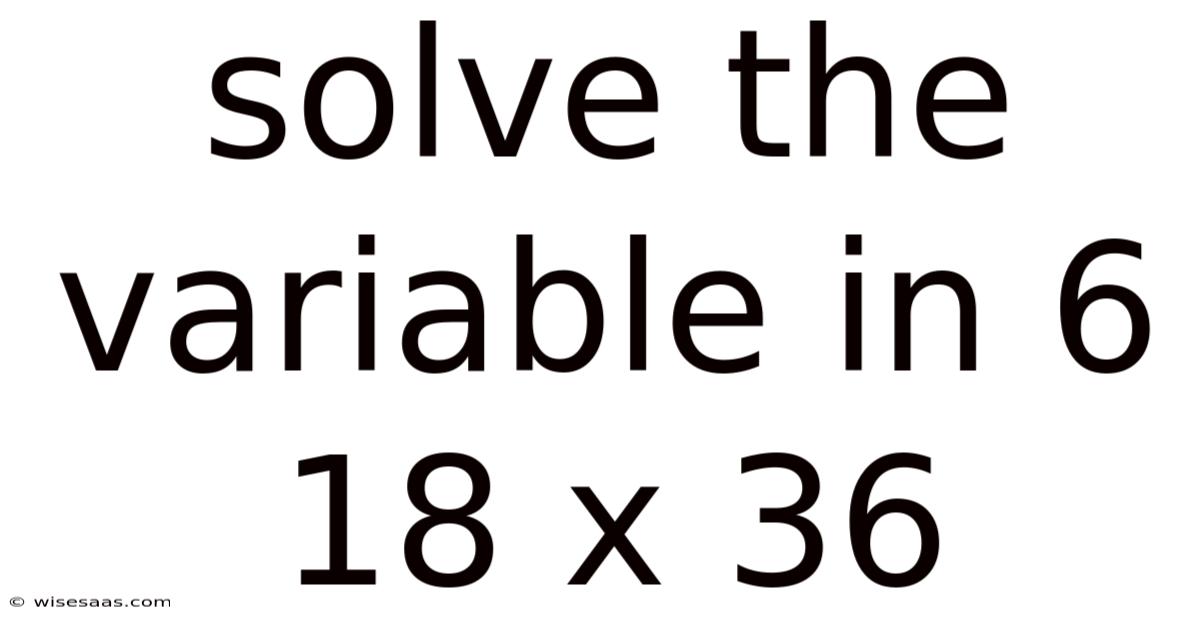
How to Solve for x in 6x + 18 = 36: A Step‑by‑Step Guide
Solving linear equations can feel intimidating at first, but with a clear, systematic approach you’ll master the process quickly. In this article we’ll unpack the equation 6x + 18 = 36, isolate the variable x, and explain every move in plain language. Whether you’re a high‑school student, a college freshman, or an adult refreshing basic algebra, the techniques below will give you confidence to tackle similar problems on exams, worksheets, or real‑world applications.
Introduction – Why Understanding Linear Equations Matters
Linear equations are the building blocks of algebra. They appear in everything from calculating distances on a map to determining profit margins in business. The equation 6x + 18 = 36 is a simple example that illustrates the core idea: find the value of the unknown that makes the statement true. By learning how to isolate the variable, you develop problem‑solving skills that translate to more complex topics such as systems of equations, quadratic functions, and even calculus.
Step 1 – Recognize the Structure of the EquationBefore jumping into calculations, identify the components of the equation:
- Coefficient: The number multiplying the variable (here, 6 in front of x).
- Constant term: The number standing alone on the left side (here, + 18).
- Equality sign (=): Indicates that the expression on the left is equal to the expression on the right (36).
Understanding these parts helps you decide which operations to perform next.
Step 2 – Isolate the Variable Term
The goal is to get x by itself on one side of the equation. Start by eliminating the constant + 18 that is added to the variable term.
-
Subtract 18 from both sides
[ 6x + 18 - 18 = 36 - 18 ] This simplifies to: [ 6x = 18 ]Why subtract from both sides?
Subtracting the same value from each side preserves equality, ensuring the equation remains balanced.
Step 3 – Eliminate the Coefficient
Now the variable is multiplied by 6. To isolate x, divide both sides by the coefficient 6:
-
Divide both sides by 6
[ \frac{6x}{6} = \frac{18}{6} ] Simplifying gives: [ x = 3 ]Key takeaway: Whatever operation you perform on one side, you must perform on the other to keep the equation valid.
Step 4 – Verify the SolutionA solid solution always checks out when substituted back into the original equation.
-
Plug x = 3 back into 6x + 18
[ 6(3) + 18 = 18 + 18 = 36 ]The left‑hand side equals the right‑hand side (36), confirming that x = 3 is correct.
Common Mistakes and How to Avoid Them
- Skipping the verification step – Always substitute your answer back into the original equation. This catches sign errors or arithmetic slips.
- Incorrectly moving terms – Remember that moving a term across the equality sign changes its sign. For example, moving + 18 to the other side becomes – 18.
- Dividing by the wrong number – Double‑check that you’re dividing by the coefficient of x, not by the constant term.
Frequently Asked Questions (FAQ)
Q1: Can I use addition instead of subtraction to isolate the variable?
Yes. If the constant were – 18, you would add 18 to both sides. The principle is always to perform the opposite operation to move a term across the equality sign.
Q2: What if the equation had fractions or decimals?
The same steps apply. First, clear any fractions by multiplying through by the least common denominator, then proceed with addition/subtraction and division as needed.
Q3: Is there a shortcut for equations of the form ax + b = c?
A quick mental shortcut is to subtract b from both sides, then divide by a. This is essentially what we did, just compressed into two mental operations.
Q4: How does this relate to graphing?
The equation 6x + 18 = 36 can be rewritten as y = 6x + 18 and y = 36. The solution x = 3 is the x‑intercept where the line y = 6x + 18 meets the horizontal line y = 36.
Q5: What if the variable appears on both sides of the equation?
First, gather all variable terms on one side and all constants on the other, then follow the same isolation steps. For example, in 6x + 18 = 2x + 42, subtract 2x from both sides to get 4x + 18 = 42, then continue as before.
Real‑World Applications
Linear equations like 6x + 18 = 36 appear in everyday scenarios:
- Budgeting: If you spend $6 per day on a hobby and have an extra $18 saved, how many days can you continue before your savings reach $36?
- Physics: Calculating uniform motion where distance = speed × time + initial offset.
- Business: Determining break‑even points where revenue (6 × units + 18) equals cost (36).
Understanding how to isolate the variable helps you translate real problems into mathematical statements and solve them efficiently.
Conclusion – Master
Building Confidence ThroughRepetition
The most effective way to cement the isolation technique is to work through a series of similar problems. Start with simple coefficients — like 2x + 5 = 13 — then gradually introduce larger numbers, negative constants, and eventually fractions. Each new variation forces you to apply the same logical sequence: move the constant term, then divide by the coefficient, and finally verify the result.
When you notice a pattern emerging — such as the fact that the sign of the constant dictates whether you add or subtract — it becomes second nature to choose the correct operation without hesitation.
Common Pitfalls to Watch For
- Misreading a negative sign: A term like – 7 on the left side becomes + 7 when you move it across the equals sign.
- Dividing by the wrong quantity: Remember that the divisor must be the exact coefficient multiplying the variable, not the constant term or the entire left‑hand side.
- Skipping the check: Even a quick substitution can save you from carrying forward an arithmetic slip into later problems.
Extending the Method to More Complex Equations
Once you’re comfortable with the basic form, you can tackle equations where the variable appears on both sides, or where parentheses require distribution before isolation. The underlying principle remains unchanged: use inverse operations to gather all variable terms on one side and all constants on the other, then simplify.
For instance, in an equation such as 3(2x – 4) + 5 = 2x + 11, you would first expand, then collect like terms, and finally isolate x using the same steps outlined earlier.
Resources for Continued Practice
- Online problem sets: Websites that generate random linear equations at varying difficulty levels let you rehearse without needing a textbook.
- Interactive tutorials: Video lessons that walk through each step in real time reinforce the procedural memory of the method.
- Peer study groups: Explaining the process to others highlights any lingering misconceptions and solidifies your own understanding.
Why Mastery Matters
Linear equations serve as the gateway to algebra and appear in countless real‑world contexts — from calculating distances and speeds to determining break‑even points in business. By internalizing the systematic approach to isolating a variable, you acquire a reliable tool that can be adapted to more abstract concepts such as systems of equations, inequalities, and even introductory calculus.
Conclusion – Mastery
Mastering the art of solving linear equations equips you with a foundational skill set that transcends mathematics, fostering logical reasoning and problem‑solving confidence that will serve you well in any analytical pursuit.
Latest Posts
Latest Posts
-
Which Of The Following Best Describes What Alveoli Are
Mar 23, 2026
-
Phrase Expressing The Aim Of A Group
Mar 23, 2026
-
When It Rains The Roads Are Most Slippery When
Mar 23, 2026
-
The Blank Took Measures To Suppress French Nationalism And Resistance
Mar 23, 2026
-
Which Of The Following Describes A Primary Source
Mar 23, 2026
