Solve The Inequality 12p 7 139

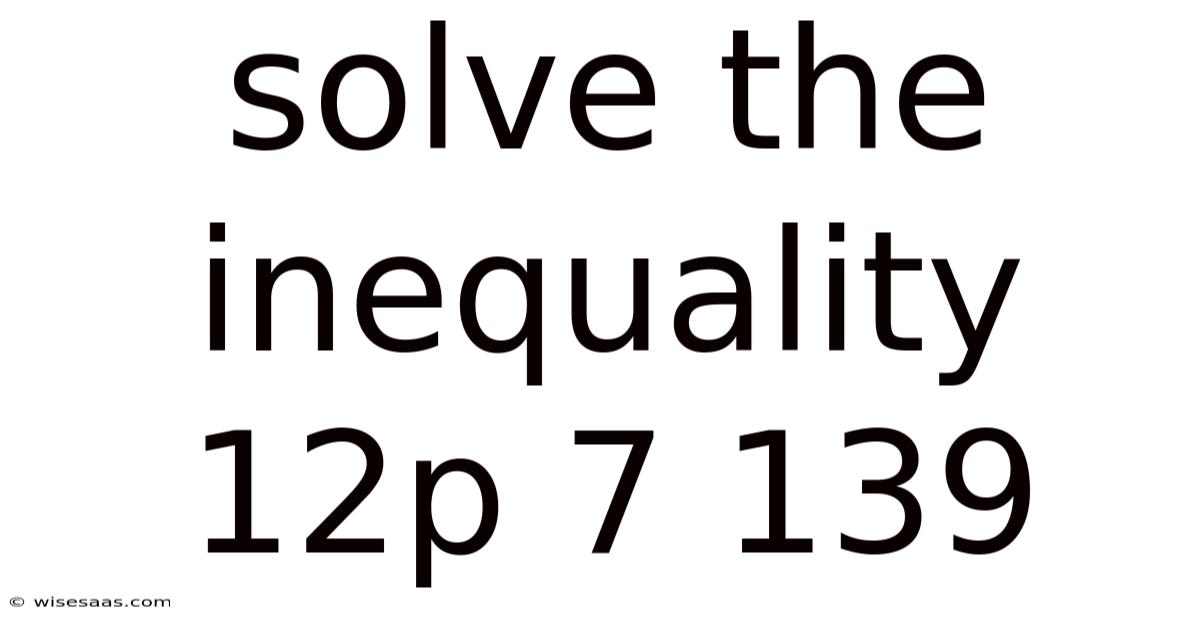
Solving the inequality 12p - 7 > 139 might seem straightforward, but it actually offers a perfect opportunity to review essential algebraic techniques. Inequalities are powerful tools in mathematics, allowing us to express ranges of possible solutions rather than single answers. Let's break down the process step by step so you can confidently solve similar problems in the future.
Step 1: Isolate the Variable Term
The first goal is to get the term containing the variable (in this case, 12p) by itself on one side of the inequality. To do this, we need to remove the constant term -7 from the left side. We accomplish this by adding 7 to both sides of the inequality:
12p - 7 + 7 > 139 + 7
This simplifies to:
12p > 146
Step 2: Divide Both Sides by the Coefficient
Now, we need to isolate p by dividing both sides of the inequality by 12. It's important to remember that when you divide or multiply both sides of an inequality by a positive number, the direction of the inequality sign remains the same. So:
12p ÷ 12 > 146 ÷ 12
This simplifies to:
p > 12.166...
Step 3: Interpret the Solution
The solution p > 12.166... means that p can be any number greater than 12.166... (or 12 and 1/6, if you prefer a fractional form). If you were to graph this solution on a number line, you would draw an open circle at 12.166... and shade everything to the right, indicating all numbers greater than this value.
Why This Process Works
Each step we took is grounded in the properties of inequalities. Adding or subtracting the same number from both sides keeps the inequality balanced, just like in equations. Similarly, multiplying or dividing by a positive number preserves the direction of the inequality. However, if you ever need to multiply or divide by a negative number, remember to flip the inequality sign—a common pitfall for students.
Common Mistakes to Avoid
- Forgetting to flip the inequality sign when multiplying or dividing by a negative number.
- Misinterpreting the solution as a single value rather than a range.
- Not simplifying fractions or decimals when possible, which can make the answer less clear.
Real-World Applications
Inequalities like this are used in many real-world scenarios. For example, a business might use inequalities to determine the minimum number of products they need to sell to make a profit, or a scientist might use them to set safety thresholds for experiments.
Frequently Asked Questions
What if the inequality was 12p - 7 < 139 instead?
You would follow the same steps, but the final answer would be p < 12.166..., meaning p can be any number less than 12.166...
Can I write the answer as a fraction?
Yes! 146 divided by 12 can be simplified to 73/6, so p > 73/6 is also a correct and often preferred form.
What happens if I multiply or divide by a negative number?
You must reverse the inequality sign. For example, if you had -12p > 146, dividing by -12 would give p < -146/12.
Conclusion
Solving inequalities is a fundamental skill in algebra that opens the door to more advanced mathematical concepts. By carefully following the steps—adding or subtracting to isolate the variable term, then dividing by the coefficient—you can solve a wide range of problems. Remember to always check your work, especially the direction of the inequality sign, and practice with different types of inequalities to build confidence. With these tools, you'll be well-prepared to tackle more complex mathematical challenges in the future.
Expanding on the Concept: Different Types of Inequalities
While the example above focused on linear inequalities, the principles apply to other types as well. Consider inequalities involving exponents, such as 2<sup>x</sup> > 8. Here, you’d need to express 8 as a power of 2 (8 = 2<sup>3</sup>) and then compare the exponents: x > 3. Similarly, inequalities with radicals, like √x + 5 < 7, require isolating the radical and then applying the same rules for manipulating inequalities. The key is to maintain the direction of the inequality throughout the process. Furthermore, inequalities with absolute values require a slightly different approach, involving considering both positive and negative cases to determine the solution set.
Checking Your Solutions
It’s crucial to verify your solution. Substitute a value slightly greater than the upper bound (for inequalities like p > 12.166...) or slightly less than the lower bound (for inequalities like p < 12.166...) back into the original inequality to ensure it holds true. For instance, if p > 12.166..., try p = 12.17. Does 12.17 > 12.166...? This simple check provides confidence in your answer.
Utilizing Technology
Calculators and online graphing tools can be invaluable resources for solving and visualizing inequalities. Graphing a linear inequality on a number line provides a clear visual representation of the solution set, reinforcing the concept of “greater than” or “less than.” Many calculators also have built-in functions for solving inequalities, though it’s still important to understand the underlying algebraic principles.
Beyond the Basics: Compound Inequalities
As you progress in algebra, you’ll encounter compound inequalities – inequalities involving “and” or “or.” For example, “2 < x < 5” means x is greater than 2 and less than 5. Solving these requires combining the solutions of the individual inequalities. Understanding the properties of unions and intersections of intervals is key to mastering compound inequalities.
Conclusion
Solving inequalities is a cornerstone of algebraic thinking, providing a powerful tool for representing and analyzing relationships between quantities. From simple linear inequalities to more complex scenarios involving exponents and radicals, the fundamental principles of maintaining inequality direction and carefully isolating the variable remain constant. By diligently applying these techniques, consistently checking your work, and utilizing available resources, you’ll develop a strong foundation for tackling increasingly sophisticated mathematical challenges and applying these skills to a wide range of real-world problems. Continual practice and a solid understanding of the underlying concepts will undoubtedly solidify your mastery of this essential algebraic skill.
Applications and Extensions
Inequalities appear frequently in real‑world contexts, from budgeting and engineering tolerances to statistical confidence intervals. For instance, when determining the feasible production levels for a factory, constraints such as cost ≤ budget and output ≥ minimum demand form a system of linear inequalities whose solution set defines the viable operating region. Graphically, this region is the intersection of half‑planes, a concept that extends naturally to higher dimensions in linear programming.
In calculus, inequalities are essential for establishing limits and continuity. The ε‑δ definition of a limit relies on bounding the difference |f(x) − L| by an arbitrarily small ε, which is itself an inequality statement. Similarly, the Squeeze Theorem (or Sandwich Theorem) uses two bounding inequalities to trap a function’s value and deduce its limit.
When dealing with data, inequalities help describe variability. Chebyshev’s inequality, for example, guarantees that for any distribution, at least 1 − 1/k² of the data lies within k standard deviations of the mean, providing a universal bound that does not assume normality.
Common Pitfalls and How to Avoid Them
- Flipping the sign incorrectly – Remember that only multiplication or division by a negative number reverses the inequality. Adding or subtracting any real number preserves the direction.
- Squaring both sides without caution – Squaring can introduce extraneous solutions because it eliminates sign information. Always check that both sides are non‑negative before squaring, or consider the separate cases for positive and negative values.
- Misinterpreting “and” vs. “or” in compound inequalities – “And” corresponds to the intersection of solution sets (the overlap), while “or” corresponds to the union (the combined set). Sketching each part on a number line clarifies which operation applies.
- Overlooking domain restrictions – When radicals or denominators are present, the variable must satisfy conditions that keep expressions defined (e.g., radicand ≥ 0, denominator ≠ 0). Incorporate these restrictions early to avoid invalid solutions.
Strategies for Mastery
- Practice with varied formats – Work on problems that mix linear, quadratic, absolute‑value, and rational inequalities to build flexibility.
- Use visual aids – Number‑line sketches, region shading on coordinate planes, and graphing calculators reinforce the connection between algebraic manipulation and geometric interpretation.
- Explain your reasoning – Articulating each step (why you added a term, why you flipped the sign, etc.) deepens understanding and helps catch subtle errors.
- Leverage technology wisely – While solvers can provide quick answers, use them to verify hand‑derived results rather than replace the reasoning process.
Conclusion
Mastering inequalities equips you with a versatile toolkit that transcends pure algebra, informing fields as diverse as optimization, statistics, and engineering. By internalizing the core principles—preserving inequality direction under safe operations, isolating variables methodically, and rigorously checking solutions—you develop a disciplined approach to problem‑solving that scales with complexity. Continued practice, mindful attention to domain constraints, and the willingness to visualize solution sets will transform inequalities from a procedural hurdle into a powerful lens for analyzing and interpreting quantitative relationships. Embrace the challenge, and let each solved inequality sharpen your mathematical intuition for the challenges ahead.
Latest Posts
Latest Posts
-
The First Major Military Engagement Of The American Revolution
Mar 27, 2026
-
How Many Tons In 20000 Pounds
Mar 27, 2026
-
In An Active Shooter Incident Involving Firearms
Mar 27, 2026
-
How Did Banking Practices Help Lead To The Great Depression
Mar 27, 2026
-
Which Incident Type Requires One Or Two Single Resources
Mar 27, 2026
