Solve The Following Equation 6y 20 2y 4

wisesaas
Mar 17, 2026 · 7 min read
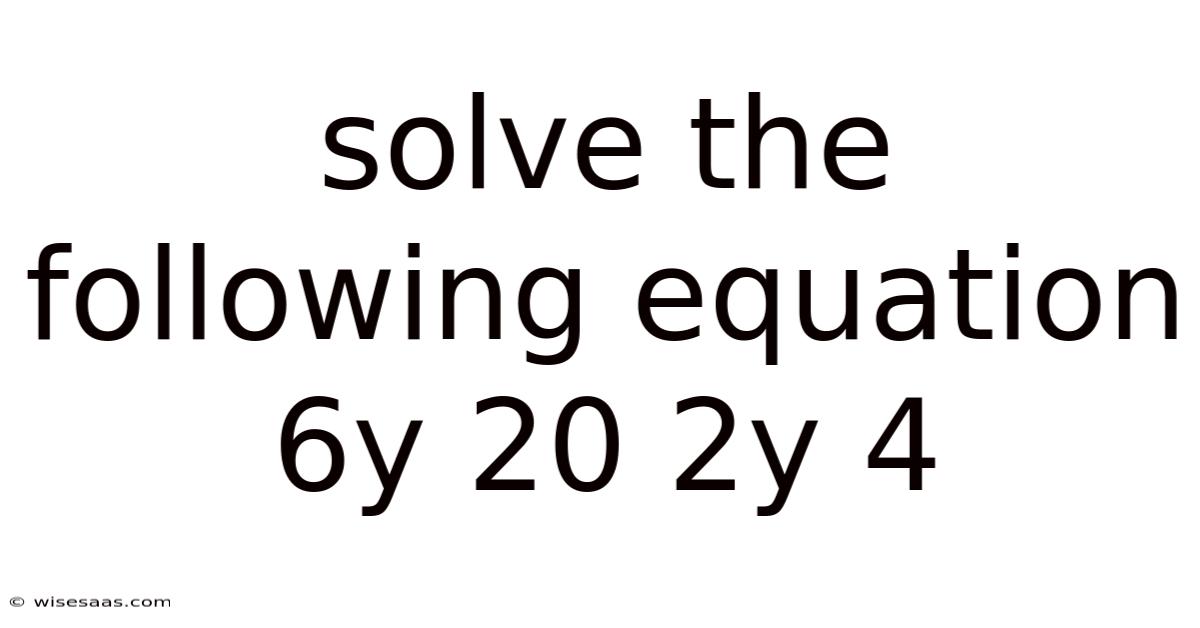
Table of Contents
Solving Linear Equations: A Step-by-Step Guide
Linear equations are fundamental in algebra and form the basis for solving many real-world problems. In this article, we'll walk through the process of solving a specific linear equation: 6y + 20 = 2y + 4. By the end, you'll have a solid understanding of the steps involved and the reasoning behind each move.
Understanding the Equation
Before we dive into solving, let's break down what we're working with. A linear equation is one where the variable (in this case, y) is only raised to the first power. The equation 6y + 20 = 2y + 4 has variables on both sides of the equal sign, which means we'll need to use algebraic techniques to isolate y on one side.
Step-by-Step Solution
-
Combine like terms: First, we want to get all terms with y on one side and all constant terms on the other. Let's move the 2y from the right side to the left: 6y - 2y + 20 = 4 Simplifying: 4y + 20 = 4
-
Isolate the variable term: Now, we'll move the constant 20 to the right side: 4y = 4 - 20 Simplifying: 4y = -16
-
Solve for y: To isolate y, we divide both sides by 4: y = -16 / 4 Simplifying: y = -4
Verification
It's always a good practice to check our solution. Let's substitute y = -4 back into the original equation:
6(-4) + 20 = 2(-4) + 4 -24 + 20 = -8 + 4 -4 = -4
Since both sides equal -4, our solution is correct.
The Science Behind the Method
The process we used to solve this equation is based on fundamental algebraic principles. The key idea is that we can perform the same operation on both sides of an equation without changing its validity. This allows us to manipulate the equation step by step until we isolate the variable we're solving for.
The concept of "like terms" is also crucial. In algebra, we can only combine terms that have the same variable raised to the same power. That's why we could combine 6y and -2y, but not 6y and 20.
Applications in Real Life
Understanding how to solve linear equations has numerous practical applications:
- Economics: Calculating break-even points for businesses
- Physics: Determining velocity or acceleration in motion problems
- Engineering: Designing structures and systems
- Finance: Calculating interest rates or loan payments
Common Mistakes to Avoid
- Forgetting to perform operations on both sides of the equation
- Incorrectly combining unlike terms
- Making arithmetic errors when simplifying
- Not checking the final answer
Advanced Techniques
For more complex linear equations, you might encounter:
- Fractions: Multiply both sides by the least common denominator to eliminate fractions
- Decimals: Multiply both sides by a power of 10 to convert to whole numbers
- Parentheses: Use the distributive property to expand before solving
FAQ
Q: What if the equation has variables on both sides? A: The process is the same. Move all variable terms to one side and all constants to the other.
Q: Can a linear equation have more than one solution? A: No, a linear equation in one variable will always have exactly one solution, unless it's an identity (infinite solutions) or a contradiction (no solution).
Q: How do I know if my solution is correct? A: Always substitute your answer back into the original equation to verify.
Conclusion
Solving linear equations like 6y + 20 = 2y + 4 is a fundamental skill in algebra. By understanding the step-by-step process and the reasoning behind each move, you can tackle a wide range of problems in mathematics and its applications. Remember to always check your work and be mindful of common pitfalls. With practice, solving these equations will become second nature, opening the door to more advanced mathematical concepts and real-world problem-solving.
This ability to isolate the variable is not just an academic exercise; it's a powerful tool for understanding relationships and making predictions in various fields. Linear equations form the foundation for modeling countless scenarios where a direct, proportional relationship exists between two or more quantities. From predicting population growth to calculating the cost of materials, these equations provide a framework for analysis and decision-making.
Beyond the basic methods, more sophisticated techniques are employed when dealing with complex equations. Systems of linear equations, involving multiple variables, are routinely solved using methods like substitution, elimination, or matrix operations. These systems are essential in fields like data analysis, where we often need to find the values of multiple unknowns based on a set of constraints. Nonlinear equations, which involve variables raised to powers other than one, or within functions like square roots or trigonometric functions, require more advanced techniques like graphing, numerical methods, or calculus to find solutions.
The importance of linear equations extends beyond pure mathematics. They underpin many areas of computer science, particularly in algorithm design and optimization. Linear programming, a branch of optimization, relies heavily on linear equations to find the best possible solution given a set of constraints. In statistics, linear regression uses linear equations to model the relationship between variables and make predictions.
In essence, mastering the art of solving linear equations is a crucial stepping stone toward a deeper understanding of mathematics and its pervasive influence on the world around us. It provides the foundational skills necessary to navigate more complex mathematical concepts and apply those concepts to solve real-world problems, empowering us to analyze, interpret, and make informed decisions. Continuous practice and a solid understanding of the underlying principles are key to unlocking the full potential of this fundamental mathematical tool.
Ultimately, the ability to confidently and accurately solve linear equations is far more than just a mathematical accomplishment; it’s an investment in analytical thinking and problem-solving prowess. It fosters a logical approach to challenges, encouraging a structured breakdown of complex situations into manageable steps. This skill translates powerfully beyond the classroom, equipping individuals with the critical thinking abilities needed to navigate the complexities of everyday life, from budgeting personal finances to understanding economic trends.
Furthermore, the principles learned while solving linear equations – identifying variables, establishing relationships, and applying logical deduction – are transferable to a wide range of disciplines. Whether you're analyzing data in a scientific study, designing a logistical system, or even making informed choices about investments, the foundational understanding gained from mastering linear equations will serve you well.
Therefore, the journey of learning to solve linear equations is not merely about memorizing formulas, but about cultivating a valuable skillset that empowers us to understand, interpret, and ultimately, shape the world around us. It's a fundamental building block for mathematical literacy and a powerful tool for navigating an increasingly data-driven society. By embracing the challenges and diligently practicing these skills, we unlock a deeper appreciation for the elegance and practicality of mathematics and its boundless applications.
The mastery of linear equations also cultivates resilience in the face of complexity. As individuals become adept at dissecting problems into linear components, they develop a mindset that embraces iterative refinement—testing hypotheses, adjusting variables, and recalculating outcomes until a viable solution emerges. This iterative process mirrors real-world scenarios where perfect answers are rare, and adaptability is key. Whether troubleshooting a software bug, optimizing supply chains, or addressing climate models, the ability to break down a problem into manageable equations fosters a proactive, solution-oriented approach. It teaches that even in uncertainty, structured analysis can lead to meaningful progress.
Moreover, linear equations serve as a universal language in collaboration. In fields like engineering, economics, or public policy, professionals from diverse backgrounds often rely on shared mathematical frameworks to communicate ideas and align goals. A well-posed linear equation can bridge gaps between disciplines, translating abstract concepts into actionable insights. For instance, climate scientists might use linear models to predict temperature trends, while economists apply similar equations to forecast market shifts. This shared toolkit not only enhances interdisciplinary teamwork but also democratizes problem-solving, enabling individuals without specialized training to contribute meaningfully to complex challenges.
In conclusion, the journey of learning linear equations is a testament to the power of foundational knowledge in unlocking human potential. It is not merely about solving for x or y, but about equipping oneself with a cognitive toolkit that transcends numerical boundaries. These skills empower individuals to approach ambiguity with clarity, to transform abstract data into tangible strategies, and to engage critically with the world’s pressing issues. As technology evolves and new challenges arise, the principles of linear equations will remain relevant, adapting to new contexts while retaining their core value. By investing time in mastering these fundamentals, we not only enhance our mathematical literacy but also arm ourselves with the analytical courage to navigate an increasingly complex and interconnected world. In this way, linear equations are more than a mathematical exercise—they are a blueprint for thoughtful, informed, and impactful living.
Latest Posts
Latest Posts
-
About One Out Of Every Ten Drivers
Mar 17, 2026
-
Insert Commas In The Following Numbers
Mar 17, 2026
-
If Electronic Media Cannot Be Physically Destroyed It Must Be
Mar 17, 2026
-
If Two Waves With Equal Amplitudes And Wavelengths
Mar 17, 2026
-
Which Of The Following Devices Imparts Ownership In A Corporation
Mar 17, 2026
Related Post
Thank you for visiting our website which covers about Solve The Following Equation 6y 20 2y 4 . We hope the information provided has been useful to you. Feel free to contact us if you have any questions or need further assistance. See you next time and don't miss to bookmark.
